

Can You Drink Tap Water in Cape Town?
Complete Drinking Water Safety Information for Cape Town
Cape Town's tap water is safe to drink and meets South African National Standard SANS 241, the national drinking water quality standard. Water supply is managed by the City of Cape Town's Water and Sanitation Department, which draws from six mountain catchment dams in the Western Cape ranges: Theewaterskloof Dam (the largest, supplying approximately 40% of the system), Voëlvlei, Wemmershoek, Steenbras Upper and Lower, and the Berg River Dam. These mountain catchments collect rainfall from the Cape Fold Mountains and produce naturally clean source water that is treated at the Faure and Vlaeberg water treatment works using conventional processes including coagulation, sedimentation, filtration, and chlorination before distribution throughout Cape Town's metropolitan network. The treated water consistently meets SANS 241 parameters at the point of supply.
Cape Town became internationally known during the 2015–2018 drought crisis that culminated in the near-legendary "Day Zero" threat — the point at which the city's combined dam levels dropped to the threshold at which municipal water supply to households would be cut off. This crisis was entirely about water quantity — the catastrophic depletion of dam storage during three consecutive years of below-average winter rainfall — and had nothing to do with water quality. Throughout the Day Zero period, Cape Town's treated tap water remained completely safe to drink. The crisis prompted extraordinary water conservation measures by Capetonians and significant investment in alternative water supply including groundwater extraction, aquifer recharge, and water reuse schemes. Cape Town's dams have since recovered substantially, and the city maintains a far more diversified and resilient supply portfolio as a result of the crisis.
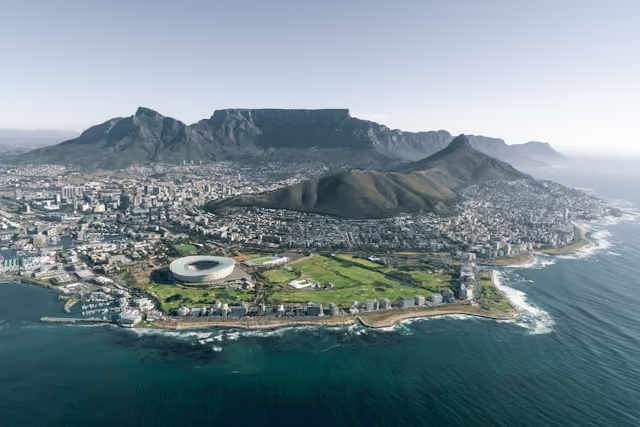
Tap water quality is consistent throughout Cape Town's diverse urban geography — from the City Bowl and CBD, the Atlantic Seaboard suburbs of Sea Point, Green Point, and Camps Bay, the V&A Waterfront precinct, the Southern Suburbs of Rondebosch, Claremont, and Constantia, and the northern suburbs including Bellville and Durbanville. Hotels, guesthouses, restaurants, and venues across all of Cape Town's neighbourhoods and township areas draw from the same City of Cape Town network, and the water is safe at every tap. The City publishes annual Blue Drop water quality assessment reports — South Africa's official water quality certification system — and Cape Town consistently achieves high Blue Drop scores.
Cape Town has a growing culture of tap water consumption, partly driven by the Day Zero experience which raised water consciousness across the city significantly. Many Cape Town restaurants now offer tap water as a default alongside sparkling and still mineral water options, and requesting tap water is entirely normal throughout the city's dining scene from the V&A Waterfront to Long Street and the Cape Winelands. Carrying a reusable bottle and refilling at hotel or restaurant taps is both safe and increasingly culturally normalised in post-Day Zero Cape Town.
For visitors exploring beyond Cape Town — on day trips to Stellenbosch, Franschhoek, and the Cape Winelands, to Hermanus and the Overberg for whale watching, or along the Garden Route toward Knysna and George — tap water is generally safe throughout the Western Cape and most South African cities, though quality and reliability can vary more in rural areas and townships away from major urban centres. Visitors to Cape Town's townships including Khayelitsha and Mitchells Plain should note that water infrastructure in informal settlement areas can be less consistent, and the drinking water situation should be verified locally in these contexts.
Bottled Water Information
Bottled water is widely available across Cape Town but entirely unnecessary for health reasons. Bonaqua (Coca-Cola South Africa), Valpre (Heineken South Africa), and Everfresh are the most widely available South African still water brands, stocked at every Pick n Pay, Woolworths Food, Checkers, SPAR, and Shoprite throughout the city. Imported brands including Evian and San Pellegrino are available at premium retailers. A 1.5-litre bottle of Bonaqua costs approximately ZAR 15–25 (around AUD $1.20–$2.00) at supermarkets, rising at tourist-area restaurants and hotels in the V&A Waterfront and Camps Bay. The only reason to buy bottled water in Cape Town is personal preference — the tap supply is completely safe and free.
Is Ice Safe in Cape Town?
Ice in Cape Town is completely safe at all establishments without exception. The City of Cape Town's SANS 241-compliant municipal supply is free from biological contamination throughout the metropolitan area. Ice at every beach club in Camps Bay, restaurant on the V&A Waterfront, bar on Long Street, and hotel in the City Bowl is completely safe. Ice quality is simply not a consideration for any visitor anywhere in Cape Town.
Should You Use a Water Filter in Cape Town?
A water filter is completely unnecessary in Cape Town. The City of Cape Town's supply consistently meets SANS 241 national drinking water standards, and the treated mountain catchment water is clean and pleasant to drink directly from any tap. Some long-term Cape Town residents use a basic activated carbon filter purely for taste preference — to soften the mild chlorine note from treatment — but this is an aesthetic choice, not a health precaution. Carry a reusable bottle and refill at any tap throughout your visit.
Should You Boil Tap Water in Cape Town?
Boiling Cape Town's tap water is entirely unnecessary. The City of Cape Town's water supply meets SANS 241 national drinking water standards with no biological safety concerns, and the treated water from the Faure and Vlaeberg works is safe at every tap in the metropolitan area. No Cape Town resident boils tap water as a safety measure — the water is safe, clean, and available free from any tap throughout the city.
Questions!
Is tap water safe to drink in Cape Town?
Yes. Cape Town's tap water meets South African National Standard SANS 241 and is completely safe to drink from any tap throughout the city. The water is treated at the Faure and Vlaeberg works from the Western Cape mountain catchment dams and is safe for all visitors and residents.
Was Cape Town's tap water safe during the Day Zero crisis?
Yes. The Day Zero crisis of 2015–2018 was entirely about water quantity — catastrophic drought depleting dam storage levels — not water quality. Throughout the crisis, Cape Town's treated tap water remained completely safe to drink. Day Zero referred to the potential cutoff of supply, not any contamination of the existing supply.
Is ice safe in Cape Town restaurants and bars?
Yes, completely. Cape Town's SANS 241-compliant municipal supply is free from biological contamination. Ice at every restaurant on the V&A Waterfront, bar on Long Street, beach club in Camps Bay, and hotel in the City Bowl is completely safe. Ice quality is not a consideration anywhere in Cape Town.
What is the best bottled water brand in Cape Town?
Bonaqua (Coca-Cola South Africa) is the most widely available South African still water brand, found at every Pick n Pay, Woolworths Food, and Checkers throughout the city. Valpre is also widely available. A 1.5-litre bottle costs approximately ZAR 15–25 at supermarkets — though the tap water is equally safe and free.
Do I need a water filter in Cape Town?
No. Cape Town's tap water meets SANS 241 national drinking water standards and is safe to drink directly from any tap. No filtration is necessary for any visitor. Carry a reusable bottle and refill at any tap throughout your visit.
We don't conduct independent water testing. We summarise and interpret publicly available official data. Conditions can change rapidly — always verify with local authorities before travelling.
Explore more destinationsSouth Africa
📚 Official Resources & Further Reading
World Health Organization (WHO) – Drinking Water Safety Guidelines
Centers for Disease Control and Prevention (CDC) – South Africa Travel Health Advice
Australian Government – Smartraveller South Africa

.svg)
