


Can You Drink Tap Water in Cairo?
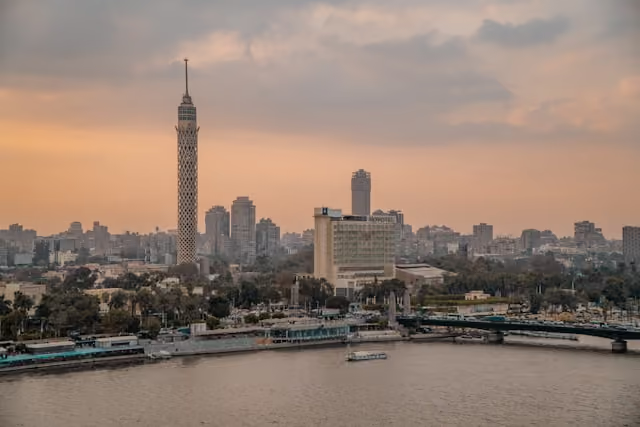
Complete Drinking Water Safety Information for Cairo
Tap water in Cairo is technically treated but not recommended for drinking by visitors — and is not consumed directly by the vast majority of Cairo's own residents. Water supply in Cairo is managed by the Cairo Water Company, a subsidiary of the National Organization for Potable Water and Sanitary Drainage (NOPWASD). The primary source is the Nile River, with water abstracted at intake points along the Greater Cairo stretch of the Nile and treated at a network of water treatment plants including the Kafr el-Elow, Shoubra el-Kheima, and Ain Shams facilities. Treatment involves coagulation, sedimentation, filtration, and heavy chlorination, and the water meets Egyptian national drinking water standards at the point of leaving the treatment plant.
The critical issue for visitors is Cairo's pipe infrastructure. Greater Cairo is one of the world's largest megacities, with a population of over 20 million people spread across an enormous urban area that has grown rapidly and unevenly over decades. The water distribution network is a patchwork of modern and extremely old pipes, with significant sections of the distribution system dating from the early 20th century, when Cairo was a fraction of its current size. These aging pipes introduce rust, sediment, bacterial regrowth, and in some cases heavy metal contamination between the treatment plant and the tap. Rooftop storage tanks, which are standard in virtually all Cairo apartment buildings, are a further quality concern — maintenance of these tanks is inconsistent, and summer temperatures frequently exceed 40°C, creating ideal conditions for bacterial proliferation in stored water.
The chlorination applied by Cairo Water Company is notably heavy — a necessary measure given the infrastructure age and the need to maintain a residual disinfectant throughout a vast distribution network. This heavy chlorination produces a strong chemical taste and odour in the tap water that is immediately detectable and widely off-putting. Even in newer, better-maintained parts of Cairo — including the upscale Zamalek island neighbourhood, the expat-heavy Maadi district, the Dokki and Mohandessin areas, and the hotel corridor along the Nile Corniche — tap water is not drunk directly by any segment of the population, and no hotel or restaurant of any category presents tap water as a drinking option.
For visitors to Cairo's major attractions — the Egyptian Museum and the Grand Egyptian Museum at Giza (the world’s largest archaeological museum), the Pyramids of Giza and Sphinx complex, Khan el-Khalili bazaar and Islamic Cairo, Coptic Cairo and the Hanging Church, and the Nile Felucca sailing experience — sealed bottled water is the universal and essential hydration source. Cairo's climate is extreme: summer temperatures regularly exceed 40°C, the city has negligible rainfall, and the combination of heat, dust, and extensive outdoor sightseeing at exposed archaeological sites means adequate hydration is a genuine health priority. Carrying more bottled water than you think you need for any Giza pyramid visit or Khan el-Khalili day is always the right approach.
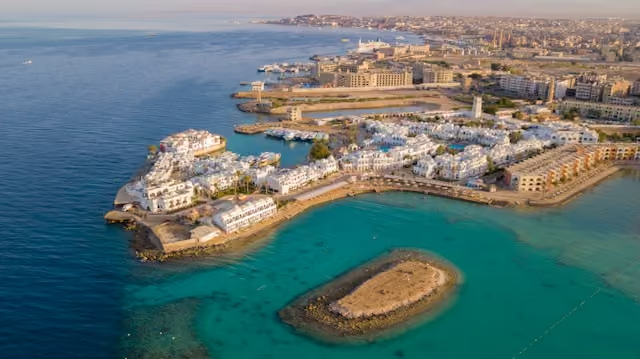
For day trips from Cairo to Alexandria, Luxor by overnight train, or Hurghada and the Red Sea coast, the same water approach applies throughout Egypt — bottled water exclusively for all drinking and tooth brushing at every destination. Baraka, Nestle Pure Life, and Siwa brands are available at kiosks and shops throughout Egypt, including at petrol stations along the Cairo-Alexandria desert road and at Luxor's tourist areas. The large-format dispenser jug delivery system is standard in Egyptian households and available at hotels with self-catering facilities in all major Egyptian cities.
Bottled Water Information
Bottled water is universally available throughout Cairo at extremely low cost. Baraka, produced from natural springs and widely considered Egypt's most trusted still water brand, is available at every kiosk, supermarket, and corner shop across the city. Nestle Pure Life and Siwa — sourced from the famous Siwa Oasis in the Western Desert — are also widely available premium options. Aqua Siwa's distinctive mineral profile makes it a popular choice at upscale Cairo hotels and restaurants. A 1.5-litre bottle of Baraka costs approximately EGP 10–20 (around AUD $0.30–$0.60) at street kiosks and minimarkets throughout Downtown Cairo, Zamalek, Maadi, and the Giza tourist corridor. Large-format 18.9-litre dispenser deliveries are standard in Cairo homes and offices.
Is Ice Safe in Cairo?
Ice safety in Cairo requires consistent awareness. At established international hotels along the Nile Corniche, tourist-facing restaurants in Zamalek and Maadi, and well-known venues near the Egyptian Museum and in the Giza hotel zone, ice is generally produced from purified or filtered water and is safe. At local Egyptian restaurants, traditional ahwa (coffeehouses), street food vendors throughout Khan el-Khalili, and smaller local establishments in Downtown Cairo and Islamic Cairo, ice quality is less certain and should be avoided unless you can confirm the source. The practical rule: established international venues — safe; local street-level establishments — request without ice.
Should You Use a Water Filter in Cairo?
A water filter is a practical option for longer stays in Cairo, particularly for visitors in self-catering apartments in Zamalek, Maadi, or Dokki where bottled water costs accumulate quickly. Activated carbon countertop filters or undersink reverse osmosis systems are widely used by Cairo's large expat community and are available from hardware stores and online. For short-stay visitors, bottled water is the more convenient and universally available solution. The large-format 18.9-litre dispenser delivery system is the most economical water solution for apartment stays of a week or more throughout Cairo.
Should You Boil Tap Water in Cairo?
Boiling Cairo tap water kills biological contaminants but does not address the heavy chlorination, mineral content, or chemical residues that make it unpalatable and unsuitable for direct consumption. Given the universal availability of bottled water throughout Cairo at very low cost, boiling is rarely a practical necessity for visitors and is not the standard approach adopted by Cairo's residents, who rely overwhelmingly on bottled water or large-format dispenser deliveries.
Questions!
Is tap water safe to drink in Cairo?
No. Tap water in Cairo is not recommended for drinking. Despite treatment by the Cairo Water Company from Nile River sources, aging pipe infrastructure, rooftop storage tanks, and heavy chlorination mean the water is not suitable for direct consumption. Virtually no Cairo resident or visitor drinks from the tap — use sealed bottled water for all drinking and tooth brushing throughout your stay.
Why do Egyptians not drink Cairo tap water if it’s treated?
Cairo's distribution network is vast and aging, with pipe sections dating from the early 20th century introducing rust, sediment, and bacterial regrowth between the treatment plant and the tap. Rooftop storage tanks, which are universal in Cairo apartment buildings, add further quality uncertainty in summer heat. Heavy chlorination makes the taste unacceptable for direct consumption. Bottled water is so affordable and available that it is simply the universal default.
Is ice safe in Cairo restaurants and hotels?
At established hotels and tourist-facing restaurants throughout Zamalek, Maadi, the Nile Corniche hotel strip, and areas near the Egyptian Museum, ice is generally produced from filtered or purified water and is safe. At local koshary restaurants, street food vendors, and small cafes throughout Downtown Cairo and Islamic Cairo, ice quality is less certain. When in doubt, request drinks without ice.
What is the best bottled water brand in Cairo?
Baraka is Egypt's most widely available and trusted still water brand, found at every kiosk, supermarket, and street stall throughout the city. Siwa, sourced from the Siwa Oasis in the Western Desert, is a premium option with a distinctive mineral profile available at hotels and upmarket restaurants. A 1.5-litre bottle costs approximately EGP 10–20 at kiosks throughout the city.
Is bottled water safe at the Pyramids of Giza?
Yes. Sealed bottled water — Baraka, Nestle Pure Life, and Siwa — is available from vendors throughout the Giza Pyramid complex and is completely safe. Always buy sealed bottles with intact caps. Carrying a sufficient supply of water for any Giza visit is essential — summer heat at the site regularly exceeds 40°C and the walk between monuments is extensive.
We don't conduct independent water testing. We summarise and interpret publicly available official data. Conditions can change rapidly — always verify with local authorities before travelling.
Explore more destinationsEgypt
📚 Official Resources & Further Reading
World Health Organization (WHO) – Drinking Water Safety Guidelines
Centers for Disease Control and Prevention (CDC) – Egypt Travel Health Advice
Australian Government – Smartraveller Egypt

.svg)
