

Can You Drink Tap Water in Prague?
Complete Drinking Water Safety Information for Prague
Prague's tap water is safe to drink and meets EU Drinking Water Directive standards throughout the city. Water supply is managed by Pražské vodovody a kanalizace (PVK — Prague Water and Sewerage Company), which draws approximately 75% of the city's supply from the Želivka reservoir in the Bohemian Highlands, around 80 kilometres south of the city. The Želivka source is a surface reservoir fed by the Želivka River, treated at the Želivka water treatment plant through coagulation, sedimentation, sand filtration, ozone treatment, UV sterilisation, and chlorination. The remaining 25% comes from the Káraný groundwater system, which draws from the banks of the Jizera River northeast of Prague through natural riverbank filtration wells similar in principle to Budapest's Danube system. Both sources produce water that consistently meets and often exceeds EU drinking water standards.
Prague's tap water has a notably soft, clean profile — the Želivka reservoir source produces water with relatively low mineral content, giving it a light, neutral taste that most visitors find pleasant. The softness is a characteristic of the Bohemian Highlands geology, where surface water accumulates without passing through the hard limestone formations that create the heavy mineral profiles of cities like Rome or London. This softness means Prague's water is gentle on the palate, leaves minimal limescale on kettles and taps, and is considered by many long-term Prague residents to be among the most drinkable tap water in Central Europe.
The tap water quality is consistent across Prague's diverse neighbourhoods — from the tourist-dense Old Town (Staré Město), Malá Strana, and Hradčany castle district on the west bank of the Vltava, to the residential Vinohrady, Žižkov, Holešovice, and Smíchov districts. Hotels, hostels, restaurants, and bars throughout Prague's historic centre all draw from the same PVK network, and the water is safe at every tap regardless of accommodation category. PVK publishes annual water quality reports that are publicly available and consistently show compliance across all monitored parameters.
Prague's relationship with tap water is somewhat more ambivalent than other safe-tap-water European cities. The Czech Republic has a strong culture of mineral water consumption — partly a legacy of the country's famous spa towns including Karlovy Vary, Mariánské Lázně, and Františkovy Lázně, where naturally mineralised spring waters have been consumed for centuries for their perceived health properties. This cultural preference for mineral water means bottled water consumption in the Czech Republic is high despite excellent tap water quality. Visitors in Prague will find restaurants often default to bottled mineral water, but requesting kohoutková voda (tap water) is perfectly acceptable and increasingly common among younger locals and the city's large expat population.
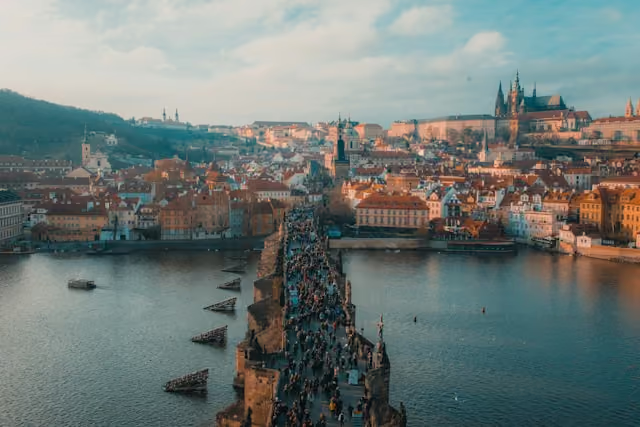
For visitors exploring Prague's most visited areas — Charles Bridge, Old Town Square and the Astronomical Clock, Prague Castle and St. Vitus Cathedral, Josefov (the Jewish Quarter), and the vibrant nightlife areas of Žižkov and Vinohrady — tap water is freely and safely available throughout. The city also has public drinking fountains in parks and squares that dispense the same PVK supply. Day trips from Prague to Český Krumlov, Kutná Hora, Karlovy Vary, or Brno offer equally safe tap water throughout the Czech Republic, which maintains consistent national water quality standards regulated by the Ministry of Health.
Bottled Water Information
Bottled water is widely available across Prague but entirely unnecessary for health reasons. Mattoni, sourced from natural mineral springs in Kyselka in the Karlovy Vary region of Bohemia, is the Czech Republic's most iconic mineral water brand — naturally sparkling and available at every Albert, Billa, Kaufland, Tesco, and convenience store citywide. Rajec (still) and Dobrá voda are also widely available Czech still mineral water brands. A 1.5-litre bottle of Mattoni costs approximately CZK 20–40 (around AUD $1.40–$2.80) at supermarkets across the city, rising at tourist-area restaurants near Old Town Square, Charles Bridge, and Wenceslas Square. Bottled water in Prague is a preference rather than a necessity — the tap water is completely safe and free.
Is Ice Safe in Prague?
Ice in Prague is completely safe at all establishments without exception. PVK's soft, clean Želivka reservoir supply is free from biological contamination and meets EU Drinking Water Directive standards throughout the city. Ice at every bar in the Žižkov nightlife district, riverside restaurant along the Vltava, beer hall in Holešovice, and hotel in Old Town is completely safe. Ice quality is not a consideration for any visitor anywhere in Prague.
Should You Use a Water Filter in Prague?
A water filter is completely unnecessary in Prague. PVK's Želivka reservoir supply consistently meets and exceeds EU Drinking Water Directive standards, and the naturally soft water is clean and pleasant to drink directly from any tap. Some long-term Prague residents use a basic activated carbon filter purely for taste preference, but this is an aesthetic choice rather than a health precaution. Carry a reusable bottle and refill freely at any tap throughout your visit — Prague's water is safe, soft, and free.
Should You Boil Tap Water in Prague?
Boiling Prague's tap water is entirely unnecessary. PVK's supply meets EU Drinking Water Directive standards with no biological safety concerns, and the distribution network across the city is modern and well-maintained. Prague's Želivka reservoir source produces naturally soft, clean water that requires no further treatment for any visitor. No Prague resident boils tap water as a safety measure.
Questions!
Is tap water safe to drink in Prague?
Yes, completely. Prague's tap water is managed by Pražské vodovody a kanalizace (PVK) and sourced primarily from the Želivka reservoir in the Bohemian Highlands. It meets EU Drinking Water Directive standards and is soft, clean, and pleasant to drink from any tap throughout the city. No bottled water is needed for health reasons during your visit.
Why do Prague restaurants serve bottled water if tap water is safe?
The Czech Republic has a strong cultural tradition of mineral water consumption, rooted in the country's famous Bohemian spa towns including Karlovy Vary and Mariánské Lázně. Restaurants defaulting to bottled mineral water is a commercial and cultural norm, not a safety indicator. Requesting kohoutková voda (tap water) is completely acceptable and increasingly common.
Is ice safe in Prague bars and restaurants?
Yes, completely. PVK's soft, clean municipal supply is free from biological contamination and meets EU safety standards throughout the city. Ice at every bar in Žižkov, restaurant in Old Town, rooftop venue in Vinohrady, and hotel in Malá Strana is completely safe. Ice quality is not a consideration anywhere in Prague.
What is the best bottled water brand in Prague?
Mattoni, naturally sparkling mineral water from the Kyselka springs in Karlovy Vary, is the Czech Republic's most iconic brand and available everywhere. Rajec and Dobrá voda are the leading still options. A 1.5-litre bottle costs approximately CZK 20–40 at Albert, Billa, or Kaufland supermarkets — though the tap water is equally safe and free.
Do I need a water filter in Prague?
No. Prague's tap water meets EU Drinking Water Directive standards and is safe to drink directly from any tap throughout the city. The Želivka reservoir source produces naturally soft, clean water that requires no further treatment. Carry a reusable bottle and refill at any tap throughout your visit.
We don't conduct independent water testing. We summarise and interpret publicly available official data. Conditions can change rapidly — always verify with local authorities before travelling.
Explore more destinationsCzech Republic
📚 Official Resources & Further Reading
World Health Organization (WHO) – Drinking Water Safety Guidelines
Centers for Disease Control and Prevention (CDC) – Czech Republic Travel Health Advice
Australian Government – Smartraveller Czech Republic

.svg)
