

Southeast Asia is Now Fully Covered on CanIDrinkTheTapWater.com
We're pleased to announce that CanIDrinkTheTapWater.com now provides complete tap water safety coverage across all 11 Southeast Asian countries. With the recent additions of Cambodia, Laos, Myanmar, Timor-Leste, and Brunei, every nation in the region now has a dedicated, detailed water safety guide for travelers and expats.
The Five New Additions
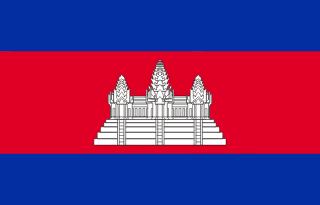
🇰🇭 Cambodia
Tap water in Cambodia is not safe to drink, even in Phnom Penh where the water authority has made internationally recognised infrastructure improvements. Contamination through aging distribution pipes and rooftop storage tanks remains a real risk. In Siem Reap — the gateway to Angkor Wat — and across the country's islands and rural provinces, bottled water is the universal standard. Our guide covers ice safety, rural water risks during the wet season, and the cheapest ways to stay safely hydrated throughout the country.
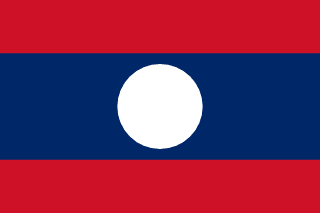
🇱🇦 Laos
Water infrastructure in Laos is limited even by Southeast Asian standards. Tap water is not safe to drink in Vientiane, Luang Prabang, or Vang Vieng, and in large parts of rural Laos there is no piped water at all. Communities along the Mekong and in the mountainous north rely entirely on rivers, wells, and rainwater. Our Laos guide is particularly detailed on trekking and rural travel, covering filter recommendations for the Nam Ou valley, the Bolaven Plateau, and northern highland routes.
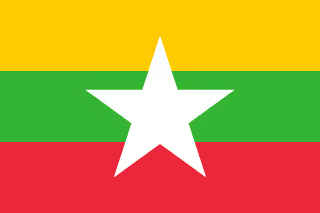
🇲🇲 Myanmar
Tap water is not safe to drink anywhere in Myanmar, including in Yangon, Mandalay, and the ancient temple city of Bagan. Myanmar's water infrastructure has faced ongoing challenges, compounded by political instability and conflict since 2021 which has disrupted services in parts of the country. Our guide covers the main tourist circuit as well as trekking in Shan State and Inle Lake, with practical advice for travelers navigating current conditions.
🇹🇱 Timor-Leste
Timor-Leste is one of Southeast Asia's youngest nations and has some of the least developed water and sanitation infrastructure in the region. Tap water is not safe to drink in the capital Dili, and outside the city, bottled water is largely unavailable. Our guide covers Dili's import-dependent bottled water supply, rural travel safety, and why carrying a quality portable filter is essentially mandatory for anyone exploring beyond the capital.
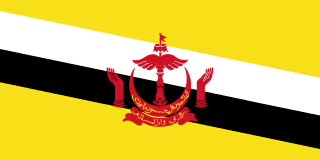
🇧🇳 Brunei
Brunei is a standout exception in Southeast Asia — tap water is safe to drink and is among the best quality in the region. Significant investment in water infrastructure, funded by the country's oil and gas wealth, means the Department of Water Services maintains a modern and reliable supply throughout the capital Bandar Seri Begawan and the main population centres. The one caveat is the remote Temburong district, where jungle lodges and eco-camps may rely on river or well water rather than treated mains supply.
The Original Six
🇮🇩 Indonesia
Tap water is not safe to drink anywhere in Indonesia, including in Bali and Jakarta. Despite being one of Southeast Asia's most visited destinations, water infrastructure across the archipelago's 17,000 islands is inconsistent and contamination during distribution is common. Our Indonesia guide covers Bali in depth — including the infamous 'Bali Belly' — as well as Lombok, Java, and what to look for in commercially produced ice at restaurants and warungs.
🇲🇾 Malaysia
Malaysia occupies a middle ground in Southeast Asia's water safety spectrum. Tap water in Kuala Lumpur and Penang is treated to reasonable standards but many residents and visitors choose to filter or boil it due to concerns about aging building pipes and rooftop storage tanks. Our guide covers KL and Penang in detail alongside East Malaysia — Sabah and Sarawak in Borneo — where water quality is less consistent outside major towns.
🇵🇭 Philippines
Tap water is not safe to drink in the Philippines, including in Manila, Cebu, and popular island destinations like Boracay and Palawan. The distribution network is compromised by aging infrastructure and intermittent supply, and waterborne illness is a documented risk. Our Philippines guide covers bottled water costs, ice safety in resort areas, and what to do in remote island locations where bottled water is not reliably available.
🇸🇬 Singapore
Singapore is the clear outlier in the region — tap water is completely safe to drink and is among the best quality in the world. The Public Utilities Board (PUB) conducts over 400,000 water quality tests annually and the city-state's Four National Taps system is a global model for water security. Visitors can drink freely from any tap in Singapore without concern.
🇹🇭 Thailand
Tap water in Thailand is not safe to drink, including in Bangkok, Chiang Mai, and Phuket. Despite municipal treatment systems, aging pipes and rooftop storage tanks mean contamination before the water reaches the tap is common. Our Thailand guide covers commercially produced ice safety, the risks of traveller's diarrhea, and affordable water options including the widely available refill stations found across the country.
🇻🇳 Vietnam
Tap water is unsafe to drink throughout Vietnam, including in Hanoi, Ho Chi Minh City, Da Nang, and Hoi An. Treatment is inconsistent and rooftop storage tanks used in most Vietnamese buildings are a significant contamination risk. Our Vietnam guide covers ice safety at street food stalls versus established restaurants, boiling recommendations, and the cheapest ways to stay hydrated across the country's diverse regions.
What's Next for CanIDrinkTheTapWater.com?
Southeast Asia is now complete, and we're continuing to expand across Asia and beyond. South Asia, Central Asia, and Africa all have significant coverage gaps that we're working through systematically. Check back regularly as new countries are added, or explore the full Southeast Asia water safety hub below.


.svg)
